Finding Solar Panel Installers With Financing in California
October 5, 2026
|
California
Rising electricity rates and growing interest in energy independence have pushed more California homeowners toward solar power than ever before. Yet the upfront cost of a solar system remains the single biggest obstacle for most households. That's why finding solar panel installers with financing has become such a critical first step in the research process. The right installer doesn't just mount panels on your roof — they help structure a payment plan that fits your budget, your credit profile, and your long-term energy goals.
This article breaks down how solar financing works, what to look for in an installer that offers flexible payment options, and how to compare loans, leases, and power purchase agreements so you can make a confident, informed decision.
A few years ago, solar was largely the domain of homeowners who could pay cash upfront. Today, the math has changed. Equipment costs have come down, but installation complexity, permitting, and battery storage additions have kept total project costs in the $15,000 to $35,000 range for most California homes. Very few families want to write that check in one lump sum.
According to the U.S. Department of Energy, most residential solar customers in the United States now use some form of financing rather than paying cash. This shift has forced installers to build financing directly into their sales process rather than treating it as an afterthought. Companies that can't offer competitive loan terms, lease structures, or PPAs are increasingly losing business to those that can.
For California homeowners specifically, financing also interacts with state and federal incentives in important ways. The federal solar tax credit, utility net metering rules, and California's NEM 3.0 billing structure all affect how quickly a system pays for itself — and financing terms need to be evaluated alongside those factors, not in isolation.
Not all financing is created equal. Before signing anything, it helps to understand the three main categories installers typically offer.
1. Solar Loans A solar loan lets you borrow the cost of the system and pay it back monthly, usually over 10 to 25 years. You own the system from day one, which means you're eligible for the federal tax credit and any state rebates. Loans can be secured (backed by your home, similar to a HELOC) or unsecured.
2. Solar Leases With a lease, a third party owns the system and you pay a fixed monthly fee to use the electricity it produces. Leases often require little to no money down, but you don't receive the tax credit, and your savings are generally lower over the life of the system.
3. Power Purchase Agreements (PPAs) A PPA is similar to a lease, except instead of a flat monthly fee, you pay for the actual electricity the system generates, usually at a rate lower than your utility's price. This can be appealing if you want predictable savings without owning the hardware.
Each structure has trade-offs in ownership, tax benefits, maintenance responsibility, and long-term value. The Solar Energy Industries Association offers a useful breakdown of how these models affect total savings over a 20-year period.
| Financing Type | Upfront Cost | System Ownership | Tax Credit Eligible | Typical Term | Best For |
|---|---|---|---|---|---|
| Cash Purchase | High | You | Yes | N/A | Maximizing long-term savings |
| Solar Loan | Low to none | You | Yes | 10–25 years | Homeowners who want ownership benefits without a big upfront payment |
| Solar Lease | None | Installer/Investor | No | 20–25 years | Homeowners prioritizing simplicity over savings |
| PPA | None | Installer/Investor | No | 20–25 years | Homeowners who want predictable, lower electricity rates |
As the table shows, loans tend to strike the best balance for homeowners who want both low upfront costs and the long-term financial benefits of ownership, including depreciation value and resale impact.
Choosing an installer isn't just about price per watt. Financing terms, warranty coverage, and installation quality all affect your total return on investment. Here are the factors that matter most.
Everysun structures its financing options around these principles, offering flexible payment plans alongside a 20-year installation guarantee and 25-year product warranties — giving homeowners confidence that both the financial and physical sides of their investment are protected.
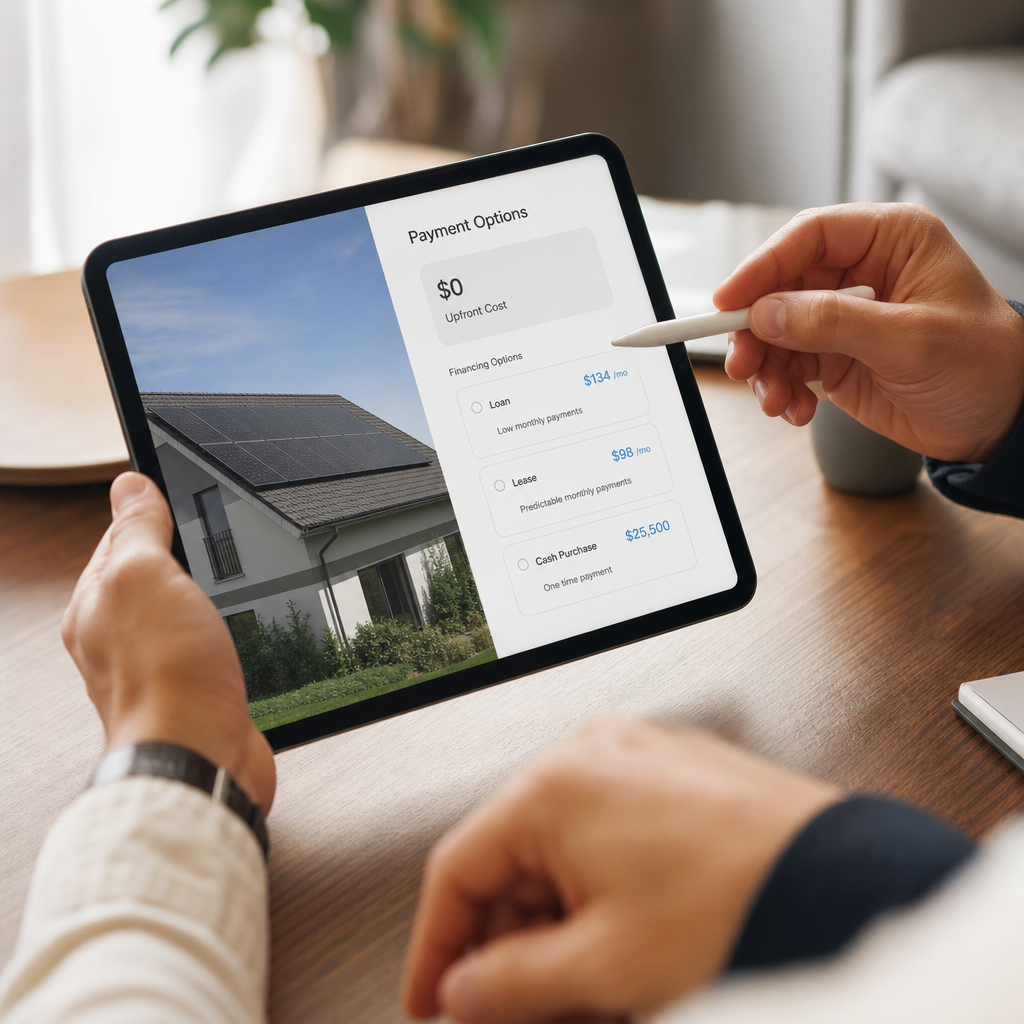
Many homeowners focus solely on the monthly payment when comparing financing offers, but that number can be misleading. Two loans with identical monthly payments can have very different total costs depending on term length, interest rate, and whether the loan is "tax-credit assisted," meaning it assumes you'll make a lump-sum payment after receiving your federal tax credit.
Here's a simplified example of how loan structure affects total cost on a $25,000 solar system:
| Loan Term | Interest Rate | Monthly Payment (Before Tax Credit) | Total Interest Paid |
|---|---|---|---|
| 10 years | 5.99% | ~$278 | ~$8,360 |
| 15 years | 6.99% | ~$225 | ~$15,500 |
| 25 years | 7.99% | ~$190 | ~$32,000 |
Longer terms reduce your monthly payment but significantly increase the total interest paid over the life of the loan. Homeowners who plan to apply their federal tax credit directly to the loan principal within the first 12-18 months can often reduce total interest substantially, since many solar-specific loans are structured as "reamortizing" loans that recalculate payments after that lump sum is applied.
The federal Residential Clean Energy Credit currently allows homeowners to claim 30% of total system costs, according to the Internal Revenue Service. On a $25,000 system, that's a $7,500 credit — a significant amount that can meaningfully reduce your effective loan balance if applied early.
Battery storage has become an increasingly important part of residential solar systems in California, particularly as NEM 3.0 reduced the value of exported solar energy and made self-consumption more financially attractive. Adding a battery typically increases system cost by $10,000 to $20,000, which makes financing even more central to the decision.
When evaluating financing for a system that includes battery storage, consider:
Everysun pairs US-made high-efficiency panels with battery storage options designed around Swedish safety and installation standards, an approach that emphasizes long-term reliability alongside affordability. Homeowners considering both solar and storage should ask installers for separate cost breakdowns to understand exactly how financing applies to each component.
Not every financing offer is as good as it sounds on paper. California's solar market has matured, but aggressive sales tactics still exist. Watch for these warning signs:
The Better Business Bureau and California's Contractors State License Board are both useful resources for verifying installer legitimacy and checking for complaint histories before committing to any financing agreement.

Before committing to any installer or payment plan, it's worth following a structured evaluation process:
Taking these steps doesn't just protect your investment — it also puts you in a stronger negotiating position, since installers are more likely to offer competitive terms when they know you're comparing multiple offers carefully.
It's worth remembering that financing isn't just about making solar affordable today — it directly shapes how much you save over the 20-to-25-year lifespan of a typical system. A loan with a slightly higher interest rate but no prepayment penalty may outperform a lease with a lower initial payment once you factor in tax credits, home equity impact, and avoided rate escalators.
Homeowners who own their systems outright (whether through cash or loan financing) also tend to see a greater boost in home resale value. Multiple studies, including research cited by the National Renewable Energy Laboratory, have found that owned solar systems can increase home sale prices, while leased systems sometimes complicate transactions because the lease must be transferred to the new buyer or paid off before closing.
This is one of the most overlooked aspects of comparing solar panel installers with financing: the structure you choose today will affect not just your monthly budget, but your flexibility if you decide to sell your home in the future.
There's no single "best" financing option for every homeowner — the right choice depends on your credit profile, how long you plan to stay in your home, your appetite for maintenance responsibility, and how you value tax credit eligibility versus simplicity. What matters most is working with an installer who presents these trade-offs clearly rather than steering you toward whichever option pays them the highest commission.
A trustworthy installer will walk you through production estimates, financing math, and warranty coverage with equal transparency, helping you choose a path that aligns with your financial goals rather than a one-size-fits-all sales pitch.
California homeowners researching solar panel installers with financing should prioritize companies that combine flexible payment structures with long-term quality guarantees. Everysun was built around that exact combination — pairing high-efficiency, US-made panels and Swedish-engineered safety standards with financing options designed to make solar ownership accessible without sacrificing installation quality or long-term protection. With a 20-year installation guarantee and 25-year product warranties backing every system, Everysun gives homeowners a financing path they can trust alongside a system built to perform for decades.
© 2025 Everysun Inc. All Rights Reserved.


Get Your Free Solar Quote
Request your free quote and see how solar can work for your home and budget