Monocrystalline vs Thin-Film vs Polycrystalline: A Solar Panel Efficiency Comparison for California Roofs
October 9, 2026
|
California
Choosing a solar panel system involves more than picking a price point. Efficiency—how much sunlight a panel converts into usable electricity—determines how many panels you need, how much roof space you'll use, and ultimately how fast your system pays for itself. For California homeowners facing high electricity rates and premium-priced roof space, understanding the real differences between panel types isn't optional; it's the foundation of a smart solar investment.
This article breaks down the major solar panel technologies available in 2026, compares their efficiency ratings side by side, and explains what those numbers actually mean for your home's energy production, budget, and long-term savings.
Efficiency refers to the percentage of sunlight hitting a panel that gets converted into electricity. A panel rated at 22% efficiency converts 22% of the solar energy it receives into usable power, while the rest is lost as heat or reflection.
This number matters because it directly affects how many panels you need to meet your household's energy demands. A higher-efficiency panel produces more electricity per square foot, which is especially valuable if your roof has limited space, multiple obstructions like chimneys or skylights, or a less-than-ideal orientation to the sun.
Efficiency isn't the only factor worth considering, but it's often the first metric homeowners encounter when comparing quotes, and it's frequently misunderstood. A panel with slightly lower efficiency isn't automatically a bad choice—it may still be the right fit depending on your roof size, budget, and climate. The U.S. Department of Energy provides a useful technical overview of how photovoltaic efficiency is measured and why it varies across technologies.
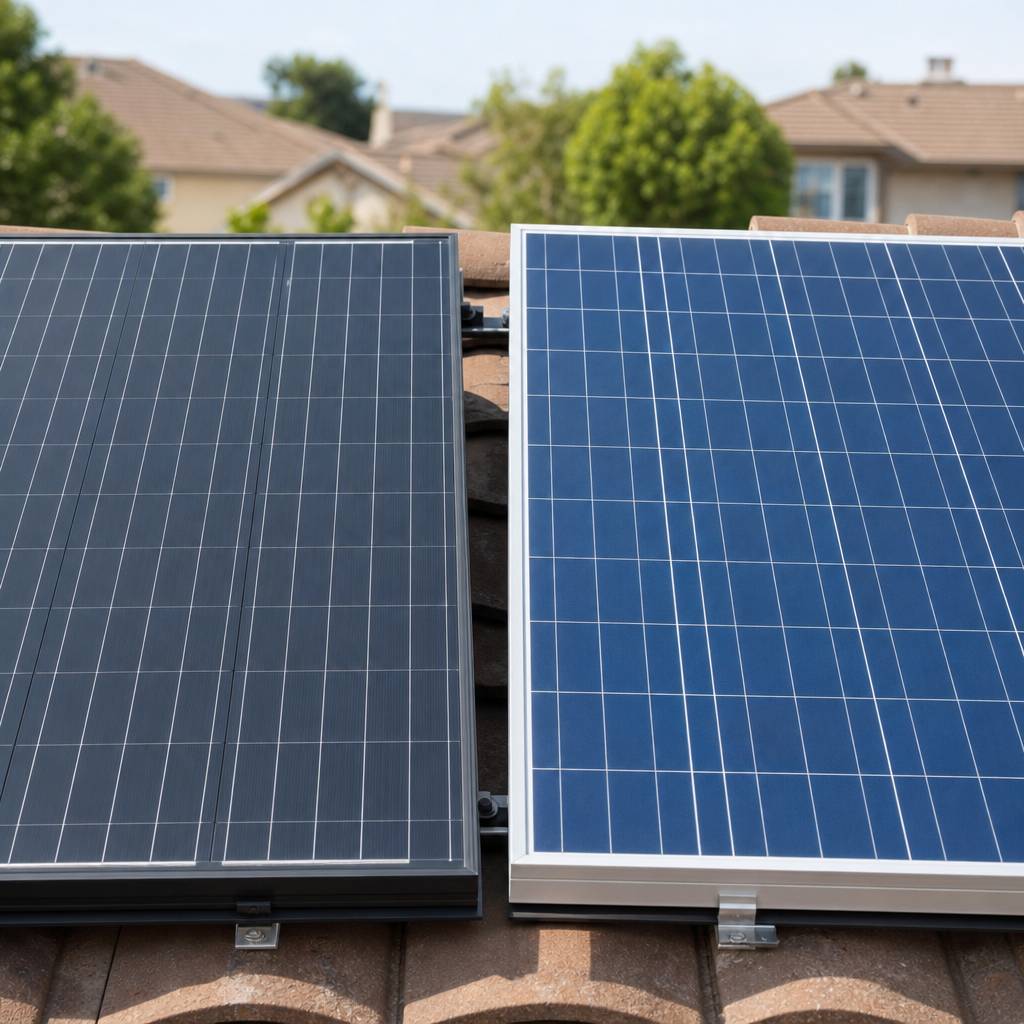
Most residential solar installations use one of three core technologies: monocrystalline, polycrystalline, or thin-film panels. Each has distinct manufacturing processes, efficiency ranges, and ideal use cases.
Monocrystalline panels are made from a single continuous silicon crystal structure. This uniformity allows electrons to move more freely, producing the highest efficiency ratings on the market—typically between 19% and 23%. They're also the most space-efficient option, making them a popular choice for California homes with smaller or more complex roof layouts.
Polycrystalline panels are made from multiple silicon fragments melted together. The manufacturing process is less refined, resulting in efficiency ratings generally between 15% and 17%. They tend to be more budget-friendly upfront but require more roof space to generate the same output as monocrystalline panels.
Thin-film panels use a different approach entirely, depositing a thin layer of photovoltaic material onto a substrate like glass or metal. These panels are lightweight and flexible, with efficiency ratings typically between 10% and 13%. They're less common in residential installations but can be useful for unconventional surfaces or specific commercial applications.
| Panel Type | Typical Efficiency | Lifespan | Best For |
|---|---|---|---|
| Monocrystalline | 19%–23% | 25–30+ years | Limited roof space, maximum output |
| Polycrystalline | 15%–17% | 23–27 years | Larger roofs, lower upfront cost |
| Thin-Film | 10%–13% | 10–20 years | Flexible or unconventional surfaces |
The National Renewable Energy Laboratory (NREL) maintains updated efficiency records for solar cell technologies and is a reliable source for tracking how these numbers evolve as manufacturing improves.
Even within the same panel category, efficiency can vary significantly between brands. This comes down to several manufacturing factors:
This is one reason Everysun focuses on US-made, high-efficiency panels built to stricter quality benchmarks. Combined with Swedish-engineered safety and installation standards, the goal is to ensure the efficiency rating on paper translates into real-world performance on your roof. You can see how www.everysun.com approaches panel selection and installation quality as part of its broader commitment to long-term system reliability.
A panel's lab-tested efficiency rating is measured under Standard Test Conditions (STC)—a controlled environment at 77°F with specific irradiance levels. Real-world conditions on a California rooftop rarely match these exact parameters, which means actual energy production will differ from the rated efficiency.
Several factors influence real-world output:
The California Energy Commission tracks approved solar equipment and performance data, which can be a helpful resource when comparing real-world specifications rather than just marketing claims.
Higher efficiency often comes with a higher price tag, but it doesn't always mean a better return on investment. The right choice depends on your specific roof size, energy usage, and budget constraints.
| Factor | Monocrystalline | Polycrystalline | Thin-Film |
|---|---|---|---|
| Average cost per watt | $2.80–$3.50 | $2.50–$3.00 | $2.00–$2.70 |
| Panels needed for 6kW system | ~14–16 | ~18–20 | ~24–28 |
| Roof space required | Least | Moderate | Most |
| 25-year degradation rate | 0.3%–0.5%/year | 0.5%–0.8%/year | 0.7%–1%/year |
For homeowners with ample roof space, polycrystalline panels can offer a lower upfront cost with a reasonable payback period. But for California homes with limited usable roof area—a common scenario in urban and suburban neighborhoods—monocrystalline panels often deliver better long-term value because they maximize output per square foot and tend to degrade more slowly over time.
It's also worth factoring in financing. Since many California homeowners use solar loans, leases, or power purchase agreements rather than paying cash upfront, the monthly payment difference between panel tiers is often smaller than the sticker price suggests. Everysun's flexible payment options are designed to make higher-efficiency systems accessible without requiring a large initial outlay, which changes the calculus for many households comparing panel types.
Efficiency doesn't just affect how much electricity you generate—it shapes the entire design of your solar system. A more efficient panel allows installers to meet your energy needs with fewer panels, which can reduce labor costs, simplify roof penetrations, and leave room for future expansion like adding battery storage.
Consider a typical California household consuming around 11,000 kWh annually:
This is particularly relevant for homes planning to add battery storage down the road. A more compact, efficient array leaves room on the roof or in the electrical design for expansion, whereas a sprawling lower-efficiency system may already be using all available space.
Everysun's design process accounts for this upfront, sizing systems not just for today's needs but with an eye toward future energy demands—including electric vehicle charging and expanded battery capacity.
Efficiency at installation is only part of the story. Every solar panel loses a small percentage of its output capacity each year, a process called degradation. This is a critical, often overlooked factor in any efficiency comparison because it determines how much electricity your system will produce in year 20 versus year one.
Premium monocrystalline panels typically degrade at a rate of 0.3% to 0.5% annually, meaning after 25 years they might still operate at roughly 88-92% of their original output. Polycrystalline panels degrade slightly faster, often landing between 75-85% of original output after 25 years. Thin-film panels generally see the steepest decline, which is part of why they're less common in long-term residential installations.
This is where warranties become essential to the efficiency conversation. A panel's efficiency rating means little if it degrades faster than advertised or fails prematurely. That's why Everysun backs its installations with a 20-year installation guarantee and 25-year product warranties—ensuring that the efficiency homeowners pay for at installation is protected over the long run. For an in-depth look at what these guarantees typically include, the Solar Energy Industries Association offers consumer-focused resources on evaluating solar warranties.

California's diverse climate zones mean efficiency considerations can vary significantly depending on where you live:
Understanding your specific climate zone helps determine whether maximizing efficiency or prioritizing durability and heat tolerance should take precedence in your panel selection.
When evaluating quotes from different installers, efficiency ratings alone don't tell the whole story. Homeowners should ask:
Asking these questions ensures you're comparing systems on equal footing rather than focusing solely on the headline efficiency percentage or price per watt.
There's no universally "best" panel efficiency rating—the right choice depends on your roof size, local climate, budget, and long-term energy goals. Homeowners with ample roof space and a tighter budget may find polycrystalline panels perfectly adequate. Those with limited space, high energy needs, or plans to add battery storage and EV charging often benefit most from higher-efficiency monocrystalline panels.
What matters most is working with an installer who designs your system around accurate data rather than one-size-fits-all packages. Everysun combines US-made high-efficiency panels with Swedish-engineered installation standards to ensure every system is tailored to the homeowner's roof, climate zone, and energy goals—not just a generic efficiency number on a spec sheet.
Comparing solar panel efficiency is about more than chasing the highest percentage on a spec sheet. It requires weighing efficiency against cost, degradation rates, climate conditions, and your home's unique roof layout. For California homeowners, where both sunlight and roof space come at a premium, getting this balance right can mean thousands of dollars in savings over a system's lifetime.
Everysun helps homeowners navigate these decisions with confidence, pairing high-efficiency, US-made solar panels with rigorous Swedish safety and installation standards, flexible payment options, and strong warranty protection. Whether you're prioritizing maximum output from a small roof or looking for the most cost-effective path to energy independence, www.everysun.com offers the technical expertise and long-term guarantees to make your solar investment both reliable and worthwhile.
© 2025 Everysun Inc. All Rights Reserved.


Get Your Free Solar Quote
Request your free quote and see how solar can work for your home and budget