Can You Qualify for Solar Panel Financing With No Credit Check?
October 14, 2026
|
California
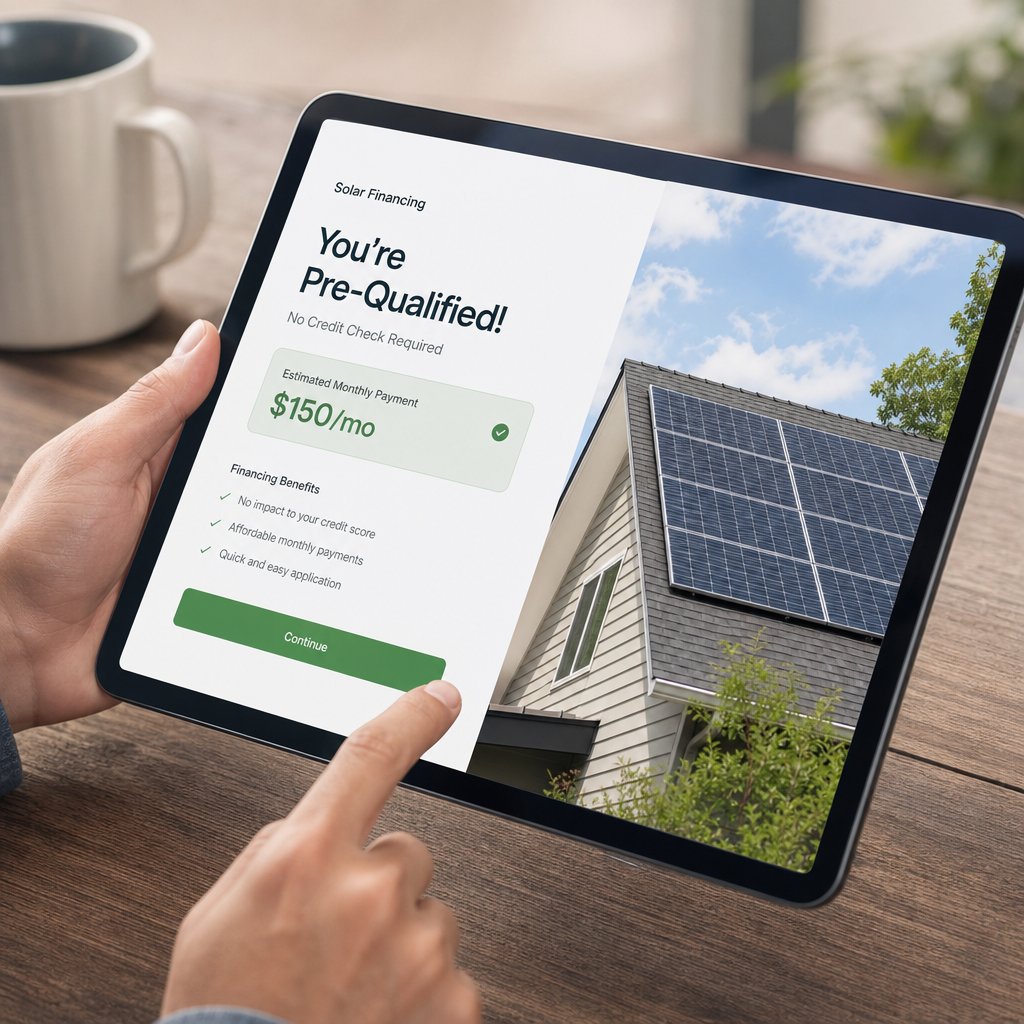
Rising electricity rates have pushed thousands of California homeowners to look seriously at solar power, but one question stops many applicants before they even request a quote: "What if my credit isn't perfect?" Searches for solar panel financing no credit check have surged as homeowners wonder whether a low score, thin credit file, or past financial setback will keep them locked out of clean energy savings. The good news is that options exist — though understanding how they actually work is essential before you sign anything.
This article breaks down what "no credit check" solar financing really means, which alternatives are available in California, how they compare to traditional loans, and how to evaluate an offer so you don't end up paying far more than necessary over the life of your system.
When a solar company advertises financing with no credit check, it rarely means there is zero underwriting involved. Instead, it typically falls into one of these categories:
It's important to recognize that "no credit check" does not mean "no qualification requirements." Lenders still want assurance they'll be repaid, so they substitute other criteria — property value, equity, or payment history — in place of a traditional credit pull. Understanding this distinction helps you compare offers honestly rather than assuming every no-credit-check program is equally favorable.
California has some of the highest residential electricity rates in the country, and under the state's current NEM 3.0 net metering structure, the value of self-consuming solar power paired with battery storage has become even more important than in prior years. According to the U.S. Energy Information Administration, California residential electricity prices remain well above the national average, which is precisely why so many homeowners want to lock in savings now rather than wait.
At the same time, not every homeowner has an 720+ FICO score. Life events — medical bills, job changes, prior bankruptcies — can suppress credit scores even when someone has strong home equity and a reliable income. For these homeowners, a rigid credit requirement can feel like an unfair barrier to a technology that could actually lower their monthly expenses.
Common reasons homeowners search for no-credit-check solar financing include:
PACE financing allows homeowners to fund solar installations through an assessment attached to their property tax bill rather than a conventional loan. Because approval is based largely on home equity and a clean property tax payment history, PACE is one of the most commonly cited "no credit check" paths in California. Programs like those outlined by the California Alternative Energy and Advanced Transportation Financing Authority operate under state oversight, though homeowners should understand that:
With a lease or PPA, a third party owns the solar system and you pay either a fixed monthly lease fee or a per-kilowatt-hour rate for the power produced. Because the provider retains ownership, approval criteria often lean more on utility payment history and income than on a hard credit pull. However, leases and PPAs typically mean:
If you have significant equity, a HELOC or home equity loan can fund solar without the same underwriting hurdles as an unsecured solar loan, since the home itself secures the debt. Credit still matters here, but approval leans heavily on your equity position.
Some installers offer their own payment plans with flexible approval standards. These can be convenient, but it's worth scrutinizing the total cost, since looser underwriting sometimes correlates with higher rates or fees.
| Financing Type | Credit Check Involved? | Ownership of System | Typical Rate Range | Best For |
|---|---|---|---|---|
| Traditional solar loan | Yes, hard pull | You own it | ~5–9% APR | Buyers with good credit seeking tax credit eligibility |
| PACE financing | Minimal, equity-based | You own it | ~6–9% (varies by assessment) | Homeowners with strong equity, limited credit history |
| Solar lease/PPA | Soft or minimal | Third-party owns it | Fixed monthly fee or per-kWh rate | Homeowners prioritizing approval ease over long-term savings |
| HELOC/home equity loan | Yes, but equity-weighted | You own it | ~7–10% APR | Homeowners with substantial home equity |
| In-house dealer financing | Varies, often lenient | You own it | Varies widely | Homeowners denied elsewhere, needing flexibility |
As the table shows, "no credit check" rarely means "no cost consideration." Each path trades something — ownership, long-term savings, or rate — for easier approval. The Consumer Financial Protection Bureau recommends homeowners compare the total cost of financing, not just the approval requirements, before signing a contract.
Even in credit-light programs, lenders and installers still want confidence you can pay. Here's what commonly substitutes for a traditional score:
Being prepared with these documents can speed up approval significantly, even under alternative underwriting models.
It's tempting to view no-credit-check financing as a pure win, but it's worth understanding the trade-offs in plain terms:
None of this means no-credit-check financing is a bad choice — for many homeowners it's the only realistic path to solar. But going in with clear eyes about the trade-offs helps you avoid surprises down the road.
Even if you're pursuing a credit-light financing path, a few steps can strengthen your position and potentially unlock better terms:

At www.everysun.com, the goal is to make solar ownership realistic for as many California homeowners as possible — not just those with pristine credit. Everysun pairs US-made, high-efficiency solar panels with Swedish-engineered safety and installation standards, and backs every project with a 20-year installation guarantee and 25-year product warranties. Just as importantly, the company offers a range of flexible payment structures designed to meet homeowners where they are financially, rather than forcing a single rigid financing model on every applicant.
Because approval criteria and loan structures can change based on market conditions, homeowners exploring alternatives to a hard credit pull are encouraged to speak directly with the Everysun team about which current programs might fit their situation — whether that's equity-based financing, a flexible payment plan, or a more traditional loan with competitive terms for those who qualify. Getting a tailored quote is the clearest way to understand real numbers rather than relying on generic advertising claims.
Before committing to any financing path — credit-checked or not — ask the provider these questions:
A reputable installer should be able to answer each of these clearly and provide documentation in writing. If a company is reluctant to disclose total costs or ownership terms, treat that as a warning sign.
Regardless of which financing path you choose, it's worth understanding how incentives interact with ownership structure. The federal Residential Clean Energy Credit, detailed by the Database of State Incentives for Renewables & Efficiency (DSIRE), currently allows homeowners who own their system — whether purchased in cash or financed through a loan — to claim 30% of eligible costs as a tax credit. This incentive does not apply to leased systems or PPAs, since the third-party owner claims it instead.
This is a critical point for anyone comparing no-credit-check options: a PACE-financed or home equity-financed system (where you retain ownership) preserves your eligibility for this credit, while a no-credit-check lease generally does not. That difference alone can be worth thousands of dollars over the life of the system, so it deserves serious weight in your decision.
| Factor | Ownership Financing (Loan/PACE/HELOC) | Lease or PPA |
|---|---|---|
| Eligible for federal tax credit | Yes | No |
| Credit check typically required | Often, though PACE is equity-based | Minimal |
| Long-term savings potential | Higher | Lower |
| Monthly payment predictability | Fixed loan payment | Fixed lease or variable per-kWh |
| System ownership at end of term | Yes | Only if buyout option exercised |
| Impact on home sale | May need payoff or transfer | May need lease transfer approval |
This comparison underscores a core truth: the easiest approval path isn't always the most financially rewarding one over 20-25 years. Homeowners with any flexibility should weigh both short-term accessibility and long-term value before deciding.
There is no single "best" answer for every homeowner. A retiree on a fixed income with strong home equity might find PACE financing ideal. A younger homeowner rebuilding credit after a financial setback might prefer a lease to start saving immediately, with a plan to refinance or purchase outright once their credit improves. A homeowner with a willing co-signer might qualify for a traditional loan with better long-term economics than any no-credit-check alternative.
The key is approaching the decision with full information: understanding what "no credit check" really means, what trade-offs come with each option, and how ownership status affects your eligibility for incentives like the federal tax credit.
Solar panel financing no credit check options do exist for California homeowners, primarily through PACE programs, leases, PPAs, home equity-based loans, and select in-house installer plans. None of these eliminate underwriting entirely — they simply shift the basis of approval from a credit score to factors like home equity, income, or property tax history. Before signing anything, compare total costs, confirm who owns the system, and understand how the arrangement affects your eligibility for valuable incentives like the federal solar tax credit.
If you're a California homeowner exploring your options, www.everysun.com offers flexible payment plans alongside high-efficiency, US-made solar panels, Swedish-grade installation standards, a 20-year installation guarantee, and 25-year product warranties — giving you a dependable partner to help find a financing path that fits your real financial picture, not just a one-size-fits-all credit requirement.
© 2025 Everysun Inc. All Rights Reserved.


Get Your Free Solar Quote
Request your free quote and see how solar can work for your home and budget