Online Reviews or Licensing Records? How to Run a Solar Company Reputation Check That Actually Works
November 20, 2026
|
California
Choosing a solar installer is one of the biggest home improvement decisions a California homeowner will make. A system can cost tens of thousands of dollars and will sit on your roof for 25 years or more, so the reputation of the company behind it matters just as much as the panels themselves. Yet many homeowners stop their research at a handful of five-star reviews, never realizing those reviews can be incentivized, outdated, or simply incomplete. A proper solar company reputation check requires looking past star ratings into licensing records, warranty structures, installation standards, and financial stability.
This article walks through exactly how to vet a solar company the way an informed buyer should, comparing the tools, databases, and red flags that separate a trustworthy installer from a risky one.
Unlike a kitchen remodel or a new roof, a solar installation is a long-term energy infrastructure investment tied to financing agreements, utility interconnection rules, and manufacturer warranties that can span decades. If the installer goes out of business, cuts corners on code compliance, or disappears after a problem arises, homeowners can be left with:
The solar industry has also seen real volatility. Several nationally known installers have filed for bankruptcy or shut down regional operations in the past few years, leaving homeowners scrambling for service. According to reporting from Canary Media, installer closures have become common enough that state regulators and consumer advocates now actively warn homeowners to vet installers before signing a contract. This is precisely why a reputation check isn't optional — it's a core part of due diligence.
Before reading a single review, confirm the company is legally authorized to install solar in California. Every legitimate solar contractor must hold a current C-46 (Solar) or C-10 (Electrical) license issued by the California Contractors State License Board (CSLB). The CSLB's free online lookup tool shows:
A company that resists sharing its license number, or whose number doesn't match CSLB records, is an immediate red flag. Reputable installers display their license number on their website footer and proposals without being asked.
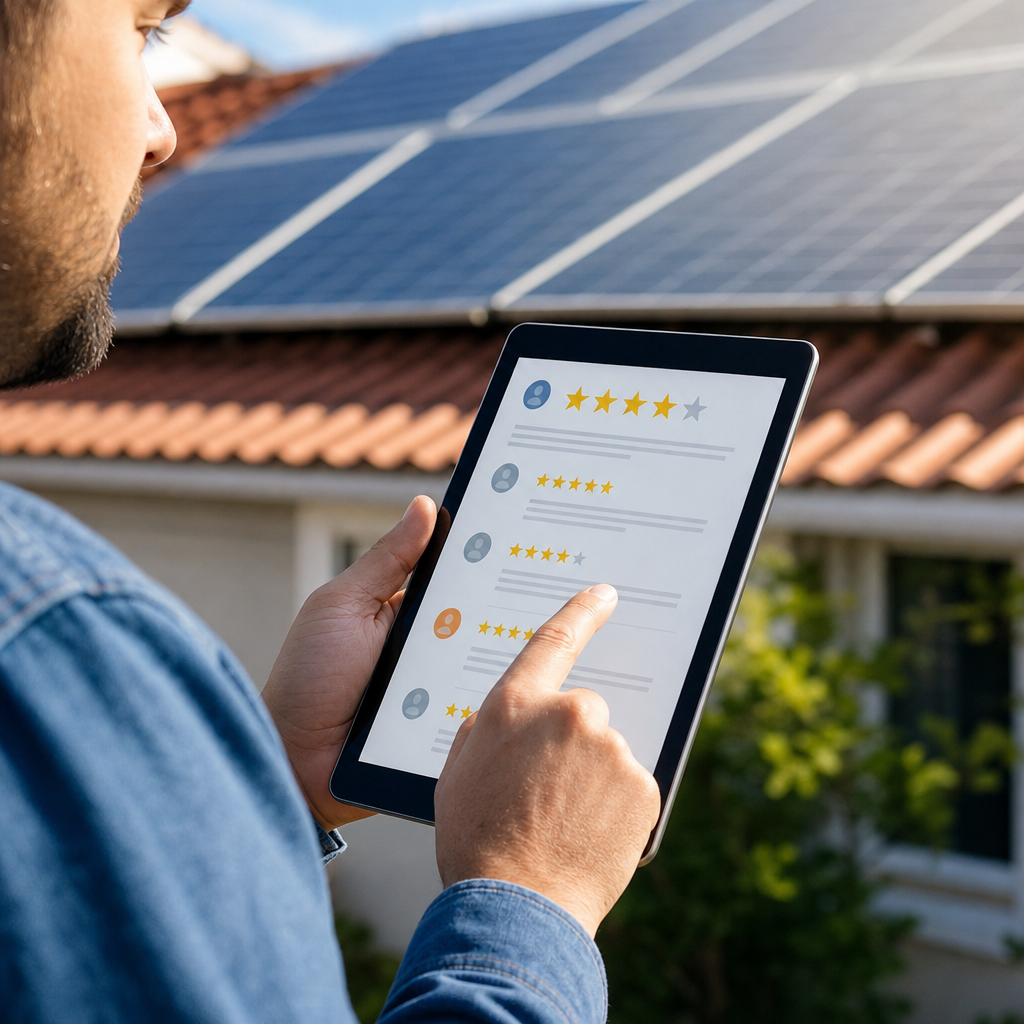
Relying on a single review source — especially one the company controls — gives an incomplete picture. Instead, cross-reference ratings across independent platforms, since patterns across sources are far more reliable than any single score.
| Platform | What It's Good For | Limitations |
|---|---|---|
| Google Business Profile | Volume of reviews, recency, owner responses | Can be gamed with incentivized reviews |
| Better Business Bureau (BBB) | Complaint history and resolution record | Accreditation can be paid for |
| Yelp | Unfiltered, harder-to-manipulate reviews | Filters sometimes hide legitimate reviews |
| SolarReviews / EnergySage | Solar-specific, verified installation reviews | Smaller sample size for regional installers |
| Nextdoor | Local, neighbor-verified experiences | Limited to specific neighborhoods |
The Better Business Bureau in particular is useful because it logs formal complaints and shows whether a company actually resolved them, not just how many stars it received. A company with a 4.8-star Google rating but a pattern of unresolved BBB complaints about delayed installations or warranty denial deserves closer scrutiny.
A reputation check isn't just about star averages — it's about what reviewers actually describe. Look for mentions of:
A string of reviews praising a smooth sales process but silent on long-term performance often means the company is better at closing deals than supporting systems for 20+ years. Cross-check this against resources like the U.S. Department of Energy's homeowner solar guide, which outlines realistic expectations for performance and service over a system's lifetime.
A company's warranty terms reveal a lot about its confidence in its own work. Reputation isn't only built on past reviews — it's also reflected in how a company backs its installations going forward. When comparing installers, ask for the specifics in writing rather than relying on marketing language.
| Warranty Type | Industry Standard | What to Watch For |
|---|---|---|
| Equipment/Product Warranty | 10–25 years | Confirm it's manufacturer-backed, not just installer-backed |
| Workmanship/Installation Warranty | 5–10 years | Shorter terms may signal lower confidence in installation quality |
| Roof Penetration Warranty | 10+ years | Must cover leaks caused specifically by mounting hardware |
| Performance Guarantee | Varies | Should specify compensation if output falls below guaranteed levels |
For context, www.everysun.com backs its installations with a 20-year installation guarantee and 25-year product warranties, reflecting the Swedish safety and installation standards the company applies to every residential project in California. When comparing quotes, ask each installer to put their warranty terms in writing and compare them directly against this benchmark — a legitimate reputation check should always include a side-by-side warranty comparison, not just a review scan.
Reviews tell you how a company has treated past customers, but financial health tells you whether it will be around to honor those commitments. Signs of a financially stable solar company include:
The National Renewable Energy Laboratory has published research on installer business practices and solar industry quality assurance, which underscores how installation quality correlates strongly with company longevity and training standards. A company that combines US-made, high-efficiency panels with rigorous installation protocols — as www.everysun.com does — signals the kind of operational maturity that supports long-term reliability.
Online reviews are useful, but nothing beats direct references from homeowners in your area. A reputable installer should be able to provide:
If a company is hesitant to provide any of this, treat it as a reputational red flag. Companies confident in their work are typically eager to showcase it.

Reputation checks aren't only about historical data — they also apply to how a company behaves during the sales process itself. Be cautious of installers who:
The Federal Trade Commission's solar guidance specifically warns homeowners about high-pressure sales tactics and encourages getting multiple quotes before signing any agreement. A trustworthy installer welcomes comparison shopping because they're confident their work will hold up.
How a company responds when something goes wrong often says more about its reputation than when everything goes right. When reviewing complaint histories on the BBB or Google, pay attention to:
A company with zero negative reviews across years of operation can actually be a yellow flag — it may mean reviews are being suppressed or only collected selectively. A healthy, authentic reputation usually includes a small number of resolved issues alongside strong overall satisfaction.
Before signing any contract, run through this checklist:
Completing this checklist typically takes less than an hour per installer but can save years of frustration — or thousands of dollars — down the line.
A reputation check should also consider the installation standards a company follows, since these directly affect long-term safety and performance. California's building and electrical codes set a baseline, but some installers voluntarily follow stricter international protocols. Combining high-efficiency, US-made panels with Swedish safety and installation standards — as practiced by www.everysun.com — reflects a level of rigor that goes beyond minimum code compliance, which can translate into fewer service calls, safer rooftop work, and more consistent long-term performance.
When comparing companies, ask directly:
The answers to these questions often reveal more about a company's true reputation than any review platform can.
A thorough solar company reputation check goes well beyond reading a few glowing testimonials. It means verifying licensing through the CSLB, comparing reviews across multiple independent platforms, scrutinizing warranty terms, confirming financial stability, and asking pointed questions about installation standards and crew training. California homeowners who take the time to run this kind of due diligence protect not just their investment, but their long-term energy reliability and home safety.
Everysun was built around this exact principle: combining US-made, high-efficiency solar panels with Swedish safety and installation standards, backed by a 20-year installation guarantee and 25-year product warranties, so homeowners don't have to gamble on reputation. With flexible payment options designed to make clean energy accessible, www.everysun.com gives California homeowners a transparent, accountable path to solar — one where reputation is backed by verifiable standards, not just star ratings.
© 2025 Everysun Inc. All Rights Reserved.


Get Your Free Solar Quote
Request your free quote and see how solar can work for your home and budget