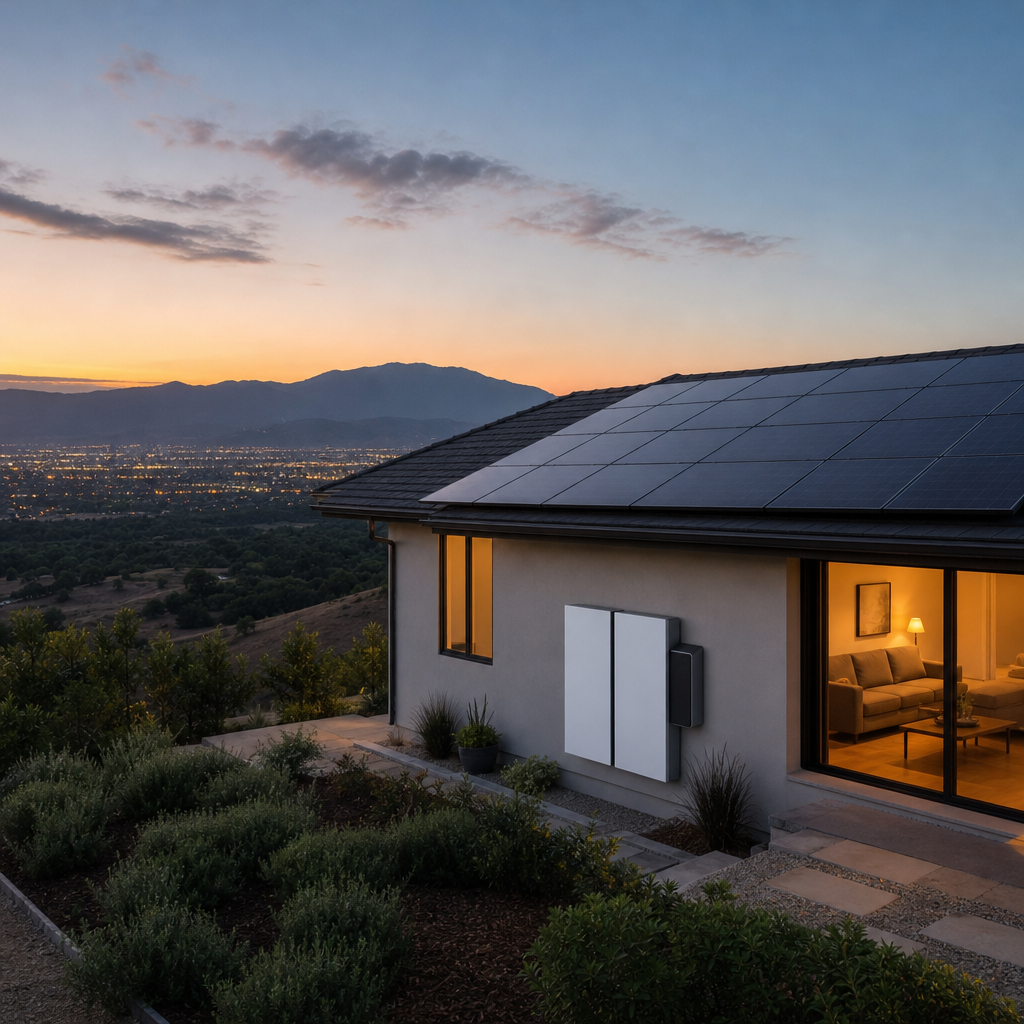
From Sunlight to Midnight: How Solar Battery Storage Works for California Homes
October 28, 2026
|
California
California homeowners have embraced solar panels for years, but a growing number are now asking a follow-up question: what happens to all that solar energy when the sun goes down? The answer lies in solar battery storage, a technology that has quickly become one of the most valuable additions to a residential solar system. Understanding how solar battery storage works can help you make smarter decisions about your energy independence, your monthly bills, and your resilience during grid outages.
This guide breaks down the mechanics, benefits, and real-world considerations of battery storage so you can decide whether it's the right fit for your home.
Solar battery storage is a system that captures excess electricity generated by your solar panels during the day and stores it for later use. Instead of sending all your unused solar power back to the grid, a battery lets you keep that energy on-site, ready to use when your panels aren't producing — at night, during cloudy weather, or during a power outage.
At its core, a solar battery system consists of a few key components:
Modern residential batteries, like those installed by Everysun, are designed to integrate seamlessly with your existing solar array, often requiring only a small addition to your home's electrical setup.
To really understand the technology, it helps to walk through the entire cycle of how energy moves from sunlight to your outlets.
This entire process happens automatically, with smart software constantly balancing your home's energy production, consumption, and storage levels. Homeowners don't need to manually manage anything — the system handles the decision-making in milliseconds.
Not all batteries are created equal. The chemistry inside a solar battery determines its safety, lifespan, efficiency, and overall performance. Most modern residential systems use lithium iron phosphate (LFP) batteries, a subtype of lithium-ion technology known for its thermal stability and long cycle life.
According to the U.S. Department of Energy, battery storage technology has advanced significantly over the past decade, with lithium-ion batteries now dominating the residential market due to their energy density and declining costs.
| Battery Type | Lifespan (Cycles) | Safety Profile | Common Use |
|---|---|---|---|
| Lithium Iron Phosphate (LFP) | 6,000–10,000 | High thermal stability | Residential solar storage |
| Standard Lithium-Ion (NMC) | 3,000–5,000 | Moderate thermal stability | EVs, some home batteries |
| Lead-Acid | 500–1,200 | Lower stability, heavier | Off-grid, older systems |
Everysun prioritizes LFP battery technology in its installations because of its superior safety record and long-term durability — a reflection of the Swedish safety standards the company applies to every project, as outlined on www.everysun.com.
Adding a battery to your solar setup transforms it from a daytime-only energy source into a true 24/7 power solution. Here are the primary advantages California homeowners experience:
The California Public Utilities Commission has detailed how NEM 3.0 reduced export compensation rates, making battery storage a much more financially sound decision for homeowners installing solar today.

Before April 2026's continued rollout of NEM 3.0 policies, many California homeowners could install solar without batteries and still see strong financial returns, because excess energy exported to the grid was credited at close to retail rates. That has changed dramatically.
Under NEM 3.0, export credits have dropped by as much as 75% compared to the previous NEM 2.0 structure, according to analysis from the Solar Energy Industries Association. This means sending surplus solar power back to the grid now earns homeowners far less than it costs to buy electricity back later in the day.
This shift has made battery storage almost essential for maximizing solar savings in California. Instead of exporting excess energy for minimal credit, homeowners now store it and use it themselves during expensive evening peak hours — when utility rates are highest and solar panels aren't producing.
| Metric | NEM 2.0 (Previous) | NEM 3.0 (Current) |
|---|---|---|
| Export Credit Rate | Near retail rate | Up to 75% lower |
| Battery Payback Value | Moderate | High |
| Grid Reliance at Night | Low (credits offset cost) | High without storage |
| Recommended System Type | Solar only or solar + battery | Solar + battery strongly preferred |
This is one of the biggest reasons Everysun now designs most residential systems with battery storage included from the start, rather than as an optional add-on.
Determining the right battery size depends on several factors specific to your household. An undersized battery won't provide meaningful backup, while an oversized one adds unnecessary cost.
Key factors that influence battery sizing include:
Most California homes pair one to two battery units (typically 10–15 kWh each) with their solar array, though homes with higher energy use or whole-home backup goals may require larger configurations. A professional energy audit, like those offered through Everysun's consultation process, ensures your battery is sized correctly for your actual usage patterns rather than generic estimates.
California's increasing frequency of extreme weather events and wildfire-related shutoffs has made grid reliability a genuine concern for homeowners. The California Energy Commission has reported that PSPS events have become a recurring seasonal reality in many high-risk counties, particularly in Northern and Central California.
Solar batteries provide a critical layer of resilience in these situations. When configured correctly, a home battery system can:
This is fundamentally different from a traditional gas generator, which requires fuel, manual startup in many cases, and regular maintenance. A solar battery operates silently, automatically, and without emissions — a meaningful advantage for homeowners who want both reliability and environmental responsibility.

Does a battery work during a power outage even without sunlight? Yes, as long as the battery has stored charge. It will power your home using that stored energy and recharge once solar production resumes.
How long do solar batteries last? Most quality lithium batteries carry warranties of 10 years or more, with usable lifespans often extending to 15 years or beyond depending on usage patterns and depth of discharge.
Can I add a battery to an existing solar system? In most cases, yes. Many inverters support retrofitting a battery, though older systems may require an inverter upgrade to accommodate storage.
Is battery storage worth it without solar panels? It's possible to install a battery and charge it from the grid during off-peak hours, but the financial and environmental benefits are far greater when paired with solar panels.
What happens if my battery is full and my panels are still producing? Once the battery reaches full charge, excess solar energy is exported to the grid under your utility's net metering agreement, subject to NEM 3.0 export rates.
Choosing to add battery storage is no longer just a nice-to-have feature — for most California homeowners, it has become a near-essential component of a well-designed solar system. Between the reduced value of grid exports under NEM 3.0, the increasing risk of power shutoffs, and the simple desire for greater energy independence, batteries now play a central role in how solar systems are designed and installed.
When evaluating battery options, homeowners should consider:
Everysun combines US-made, high-efficiency solar panels with rigorous Swedish safety and installation standards, backed by a 20-year installation guarantee and 25-year product warranties. This approach ensures that both the solar and battery components of your system are installed correctly the first time, minimizing risk and maximizing long-term performance.
Solar battery storage has transformed from a niche upgrade into a foundational element of smart residential solar design in California. By capturing daytime solar energy and making it available around the clock, battery systems help homeowners reduce their electricity bills, maintain power during outages, and adapt to the realities of NEM 3.0's reduced export credits. Understanding how the technology works — from charge controllers to battery management systems to seamless grid switching — empowers homeowners to make informed, confident decisions about their energy future.
If you're ready to explore how a properly sized solar and battery system could work for your home, the team at www.everysun.com offers personalized consultations, flexible payment options, and installation backed by industry-leading warranties. With Everysun, California homeowners get a system built not just to generate clean energy, but to store and deliver it reliably for decades to come.
© 2025 Everysun Inc. All Rights Reserved.


Get Your Free Solar Quote
Request your free quote and see how solar can work for your home and budget