$16,000 to $35,000: What Solar Panels Really Cost for a House in 2026
August 31, 2026
|
California
Homeowners researching solar almost always start with the same question: how much do solar panels cost for a house? The honest answer is that most residential systems in the United States run between $16,000 and $35,000 before incentives, with the typical California household landing around $22,000 to $28,000 for a system large enough to offset most of their electricity bill. That range depends heavily on your roof size, energy usage, equipment quality, and local labor costs.
This article breaks down the real numbers behind solar pricing in 2026, including cost per watt, financing options, incentive savings, and the factors that push your quote up or down. We'll also show you how a properly designed system pays for itself over time rather than simply adding another monthly expense.
Solar pricing is usually quoted in dollars per watt ($/W), and as of 2026 the national average sits around $2.80 to $3.50 per watt before any tax credits or rebates. Your total price scales with the size of the system, measured in kilowatts (kW), which is determined by your home's energy consumption, roof space, and sun exposure.
| System Size | Estimated Cost Before Incentives | Estimated Cost After 30% Federal Tax Credit | Typical Homes Served |
|---|---|---|---|
| 4 kW | $11,200 – $14,000 | $7,840 – $9,800 | Small homes, low usage |
| 6 kW | $16,800 – $21,000 | $11,760 – $14,700 | Average 1,500–2,000 sq ft home |
| 8 kW | $22,400 – $28,000 | $15,680 – $19,600 | Larger homes, moderate-high usage |
| 10 kW | $28,000 – $35,000 | $19,600 – $24,500 | Large homes, pools, EV charging |
| 12 kW | $33,600 – $42,000 | $23,520 – $29,400 | High-consumption households |
Most California homeowners fall into the 6 kW to 10 kW range, especially if they run air conditioning, an electric vehicle, or a pool pump. Adding battery storage, which is increasingly common given California's time-of-use electricity rates and net billing rules, typically adds another $10,000 to $18,000 depending on capacity.
No two solar quotes look identical, even for similar-sized homes. Several variables determine where your project lands within the pricing range.
Because home sizes and energy needs vary so widely, comparing total dollar amounts between quotes can be misleading. Cost per watt normalizes pricing so you can compare apples to apples.
| Cost Per Watt Range | What It Typically Means |
|---|---|
| $2.00 – $2.50/W | Entry-level equipment, smaller installers, may lack strong warranties |
| $2.50 – $3.00/W | Mid-range equipment with solid workmanship and standard warranties |
| $3.00 – $3.75/W | Premium panels, extended warranties, high-efficiency inverters, and stronger installation guarantees |
| $3.75/W+ | High-end battery integration, complex roofs, or premium brand systems |
When you receive quotes, ask installers to state their price per watt so you can see exactly what you're paying for equipment and labor versus what's being marked up. According to the U.S. Department of Energy's Solar Energy Technologies Office, understanding this figure is one of the most effective ways to avoid overpaying.
California remains one of the best states for solar adoption despite having some of the highest electricity rates in the country, which is exactly why solar makes financial sense here. The state's abundant sunshine, combined with high utility rates from providers like PG&E, SCE, and SDG&E, means solar systems tend to pay for themselves faster than in most other states.
Key California-specific cost factors include:
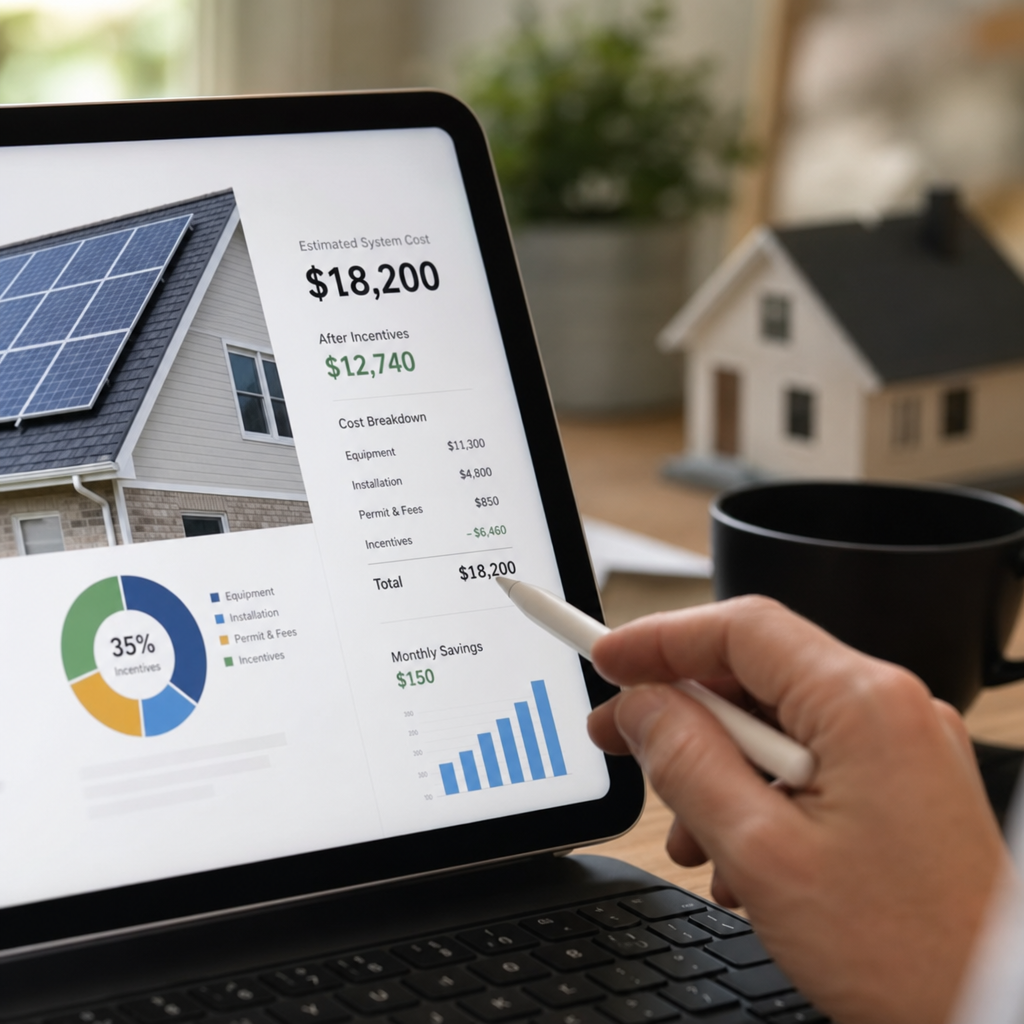
Very few homeowners pay the full amount upfront in cash, though doing so provides the best long-term return since there's no interest cost. Here are the most common ways California homeowners finance solar in 2026:
Everysun offers flexible payment options designed to make solar accessible without requiring a large upfront cash outlay, including financing structured around a homeowner's actual usage and budget. This approach lets California families start saving on their electric bill from month one rather than waiting years to break even.
| Financing Method | Upfront Cost | Ownership | Tax Credit Eligible | Long-Term Savings |
|---|---|---|---|---|
| Cash Purchase | High | Yes | Yes | Highest |
| Solar Loan | Low to none | Yes | Yes | High |
| PPA | None | No | No | Moderate |
| Lease | None | No | No | Moderate |
| HELOC | Low to none | Yes | Yes | High |
One factor homeowners frequently underestimate is how fast utility rates are climbing. California electricity prices have risen significantly over the past decade, driven by grid infrastructure investments, wildfire mitigation costs, and rising demand. According to data compiled by the California Public Utilities Commission, residential rates in major service territories have increased by double-digit percentages in recent years alone.
This matters because a solar system locks in a large portion of your energy costs at today's installation price, effectively protecting you from future rate hikes for the 25-plus year lifespan of the panels. Homeowners who delay installation continue paying ever-increasing utility bills while the cost of solar equipment has remained relatively stable or even declined slightly due to manufacturing improvements.
Consider this simplified comparison over a 20-year period for an average California household using 900 kWh per month:
| Scenario | Estimated 20-Year Electricity Cost |
|---|---|
| No solar (rates rise ~4% annually) | $130,000 – $160,000 |
| Solar system installed today (cash or loan) | $22,000 – $30,000 total system cost, plus minimal grid fees |
| Solar with battery storage | $32,000 – $45,000 total system cost, plus minimal grid fees |
Even accounting for financing interest, most homeowners save well over $80,000 across two decades by switching to solar rather than continuing to pay a rising utility bill.
Beyond monthly bill savings, solar installations tend to increase resale value. Research from Zillow has found that homes with solar panels sell for a premium compared to similar homes without them, and they often sell faster in competitive markets. Buyers increasingly view solar as a desirable feature rather than a novelty, especially in a high-electricity-cost state like California.
Key value-related benefits include:

Because pricing varies so much based on individual home characteristics, the only way to get a truly accurate number is a personalized assessment. When evaluating quotes, homeowners should:
Everysun provides detailed, transparent quotes for California homeowners that break down equipment, labor, and financing clearly, so families can make an informed decision without guesswork. Visit www.everysun.com to request a personalized cost estimate based on your specific roof, usage, and budget.
Even with a general understanding of pricing, many homeowners overpay or end up with underperforming systems due to avoidable mistakes:
Avoiding these pitfalls is one of the simplest ways to ensure your solar investment delivers the savings you expect.
So, how much do solar panels cost for a house in 2026? For most California homeowners, expect a range of roughly $16,000 to $35,000 before incentives, or $11,000 to $25,000 after the federal tax credit, depending on system size, equipment quality, and whether you add battery storage. While that's a meaningful investment, it's one that typically pays for itself within six to nine years in California given the state's high electricity rates, and continues generating savings for decades afterward.
The best way to get an accurate number for your specific home is a personalized quote that accounts for your roof, energy usage, and goals, whether that's simply lowering your bill or achieving full energy independence with battery backup. Everysun combines US-made high-efficiency panels, Swedish-standard safety and installation practices, a 20-year installation guarantee, and 25-year product warranties to give California homeowners a solar system built to perform reliably for decades. With flexible payment options designed to fit real household budgets, www.everysun.com makes it straightforward to move from rising utility bills to predictable, clean, and affordable home energy.
© 2025 Everysun Inc. All Rights Reserved.


Get Your Free Solar Quote
Request your free quote and see how solar can work for your home and budget